
Article
Human-Centered Design: The right investment, the first time around
In 2016, I uprooted my family from a one-bedroom high-rise condo in downtown Chicago to a house in the less dense city of Raleigh, NC. It was a massive life change, and as we settled and adapted to our new surroundings, I noticed a few things that were not what I imagined. And the experience got me thinking about what my Human Experience (HX) team and I do every day at Altera Digital Health. Let me explain.
In one of our bathrooms, the light switch is reversed. When you flick it down, the light goes on. Opposite to how all of the other light switches in our house (and in our general lives) work. Sure, this is easy enough to adapt to, and certainly something an inspector should have caught, but we can easily fix it if we want. But it took a while to adapt, all the same. Then two scenarios washed over me. What if, say, this house had light switches in rooms that didn’t connect to the rooms itself? Like if the one in the kitchen actually turned on the light in the garage? Or, maybe worse, what if the sinks in our primary bathroom each only had hot or cold water? It is possible, for some reason, the previous owners might have preferred it this way. But for us? We would have insisted these were fixed before we closed. Surely each would cost us a decent amount of money to fix, but it shouldn’t have to.
Both of these predicaments are highly unlikely to occur when buying a home (at least I hope so!), but as they serve as metaphors for how some organizations might view their EHR systems, this is where the importance of Human-Centered Design methodologies comes into play. An EHR solution used every day, and one that holds a great deal of importance for both the staff and patient experiences, should fit your organization’s needs as they continue to grow and change. And it shouldn’t cost organizations more money to get their health technologies to work for them, not against.
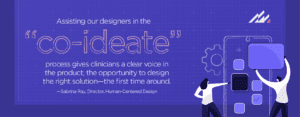 Having the wrong solution costs your organization downtime and burnout. At Altera Digital Health, we know how essential finding the right solution is. But how much better could that solution be if it were designed alongside those using it consistently? Similar to being an active participant in the constructing of your dream house, our Human-Centered Design process enables clinicians and designers to work together on a solution that can specifically meet and exceed an organization’s needs. Assisting our designers in the “co-ideate” process gives clinicians a clear voice in the product; the opportunity to design the right solution—the first time around. Since the initial investment is in the solution that was designed specifically for your organization, you’re not needlessly spending money down the road to fix something that doesn’t work for you.
Digging in on the co-ideate stage of this process, participation positions the users to enhance the final product, ranging from easy-to-fix issues to large restructuring concepts. The HX design team can translate problems discussed into a solution rapidly by designing a quick prototype. Prototypes are taken through additional co-ideates and rapidly iterate on the feedback. Then this is where we put the investment in the business to build the right solution the right way. At its core, working with the HX designers during these co-ideate sessions helps drive continuous improvements. Furthermore, ongoing partnerships enable the HX design team to gain deep insights—rather than conversational Q&As or focus groups—which spurs the HX team to unpack the problems and get to fixing the root causes, not just what is on the surface.
As we know, healthcare solutions are enormous investments—in terms of importance to care delivery as well as monetarily. Making the decision to invest in a solution carries enormous weight, and the specific solution users will have the best ideas of what works and—maybe more importantly—what doesn’t. We’ve already seen success in partnering directly with solution users to design the right solution, the first time around. Our Human-Centered Design process gives power to the user and valuable information to the designer, creating a mutually beneficial partnership that creates a solution that deserves initial investment, not fixing after. If you’d like to learn more about our thoughts surrounding financial stability, click here.
About the author

Related Insights








Article