
Article
Three market shifts cutting into your organization’s bottom line
Clinical leaders often say that a patient’s health is largely shaped by what happens outside the four walls of a hospital. In some ways, you could say the same when it comes to the financial health of a healthcare organization. There will always be market factors beyond the control of a hospital or practice that affect bottom lines. Organizations’ leaders need to stay on top of these influences while also finding opportunities within their control to cut costs and maximize reimbursements.
Here are a few current trends in the market to be mindful of as they relate to organizations’ finances.
Drug prices ingesting capital
Prescription drug pricing is often highlighted as a major burden for many patients, but it is also a significant challenge for healthcare organizations themselves. According to a study in the American Journal of Health-System Pharmacy, in 2021, drug expenditures increased by 8.5% for non-federal hospitals and 7.7% for clinics. Additionally, data from HHS indicates that the price of more than 1,200 prescription drugs exceeded the inflation rate (8.5%) from July 2021–July 2022; and the average price increase for these drugs was 31.6%.
 Labor costs becoming laborious
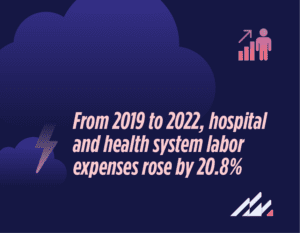
The healthcare workforce shortage has been steadily growing for years. Pressures brought on by the COVID-19 pandemic only deepened the issue as more providers opted for early retirement or career changes. As a result, healthcare organizations have had to play an increasingly difficult game of catch up when it comes to staffing. A report from the American Hospital Association (AHA) found that from 2019 to 2022, hospital and health system labor expenses rose by 20.8%.
To close staffing gaps, healthcare organizations have had to rely on contractors and staffing agencies even more, and bringing in contracted providers is typically more costly than full-time employees. Additionally, since organizations have had smaller pools of providers to work with, full-time employees and contractors have also worked more overtime, which is also more expensive for organizations. According to the AHA, overtime hours at hospitals rose more than 15% from 2019 to 2022.
Supplies demanding greater spend
Rising inflation has affected consumers and businesses across multiple sectors, and healthcare is no exception. This is evident through increases in the cost of medical supplies. Data from Definitive Healthcare reveals that from 2017 to 2021, the total medical and surgical supply costs for hospitals increased by an average of 6.5% each year. Businesses, including healthcare organizations, have also had to deal with supply chain challenges, which may have forced them to seek alternate (and potentially more pricey) vendors for needed supplies.
Is your organization looking to streamline bottom lines in light of these challenges? Learn how you can achieve and sustain financial stability here.
About the author

Related Insights











Article